Nazi anti-Jewish restrictions
The Glass RoomNazi anti-Jewish restrictions transform persecution from a public policy into an intimate, cumulative condition of life: Jews are barred from ordinary spaces and occupations, compelled to display a yellow star, and eventually rounded up and deported. In the novel, the restrictions are seen both through the testimony of those who confront them and through the institutions that classify people in the name of science. Their force lies in the widening gap between formal rules, personal identity, and the protection that documents or social connections might appear to offer.
Restrictions in Everyday Life
In a letter from Hana, Liesel learns that Oskar can do less and less. He once liked to wear a buttonhole, a rose or carnation; now flowers are unavailable except for a poor imitation of the Star of Bethlehem made from yellow cloth. Oskar refuses to leave the house wearing it. The imposed marker has displaced the ordinary flower that expressed his sense of how to dress, and his refusal turns a restriction on public appearance into confinement at home. Hana, the letter says, is now the only one who goes out.
Reading the letter, Liesel recognizes the yellow star from recent newspaper reports and understands that Oskar has been made to wear one. Ottilie asks whether her father would have to wear it if they were still at home; Liesel answers yes. Asked whether the children would have to wear it too, she cannot say. Her disbelief at the rule does not soften its implications: she compares the marking of Jews to branding cattle. The exchange makes the policy legible across generations. A symbol imposed on Oskar becomes a question about the children’s own possible exposure, and the family’s departure is measured against the life they would have faced had they remained.
Prohibitions and Deportation
When Hana presses Stahl about the treatment of Jews, she lists the restrictions as a connected assault on ordinary life. Jews cannot shop during normal hours, travel on trams, enter cafés or hotels, or use public parks. They cannot own pets or telephones, or hold decent jobs. They must wear a label, and now they are being rounded up and deported. The accumulation matters: exclusion reaches transport, leisure, work, possessions, and public visibility before it reaches the more overt violence of arrest and removal. Hana argues that the measuring apparatus around them should make Stahl understand what is happening; his response instead treats the persecution as a problem requiring a solution.
The novel also conveys the scale of the violence through uncertain, circulating information. Hana reports that thousands of Jews have been rounded up in Prague and sent to Poland; the figure repeated in conversation is five thousand. Rumours say that the fortress at Terezín is being turned into a ghetto where Jews will be concentrated. Stahl presents this possibility as a practical solution. The contrast between Hana’s alarm and his casual, administrative phrasing shows how persecution can be normalized in the language of expediency, even as the facts reach people through rumours and incomplete reports.
A later letter reports that Hana and her husband have both been arrested. Oskar, identified as a Jew, is said to have been sent to Theresienstadt, the German name used in the letter for Terezín. Hana’s fate is less certain: some say she was sent to Germany, others to Austria, to a work camp. The writer cannot confirm more. The uncertainty is itself part of the restrictions’ consequence: arrest removes people from view, while those left behind receive scattered accounts that cannot establish where someone has gone or whether they are safe.
Classification as Administrative Power
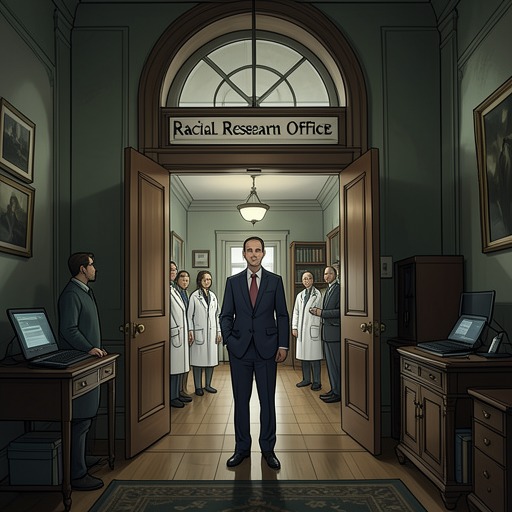
The biometric centre gives persecution another institutional form. Groups of visitors arrive by bus, around a dozen at a time, divided by sex and approximately by age. Staff direct them politely and speak Czech or German as required. The stated procedure sounds orderly and respectful, but the intake form asks for birthplaces, languages, religion, race, and nationality, as well as diseases and conditions attributed to a person’s ancestry, including alcoholism, criminality, and mental retardation. A claim of confidentiality and pure science accompanies the collection of information that makes each subject administratively legible to the institution.
After completing forms, subjects perform tests involving shapes, sequences, and patterns, then change into medical gowns. Staff take blood from a needle prick and measure blood pressure. In the measurement rooms, one worker records while another positions each person against a stadiometer: legs apart, heels, buttocks, and shoulder blades against the backboard, head held in place and chin level. Examiners kneel to adjust bodies until each measurement is standardized. They record height, hip and chest diameter, sitting measurements of arms and legs, and head dimensions with callipers in a dentist’s chair. Skin is matched to a von Luschan chromatic chart; eye colour is compared with rows of model eyes. The assurances that there will be no pain or discomfort cannot disguise the bodily control built into the procedure.
The narrative calls the result precision and the cool gaze of scientific objectivity, but links that ideal to the exact dimensions of the Glass Room itself. The apparent neutrality of the measurements is therefore not separate from the coercive system surrounding them. Stahl’s account to Heydrich acknowledges that not all Jews have the diseases invoked by racial doctrine, and that people with those diseases are not all Jews. The centre instead seeks minute variations in phenotype and combinations of characteristics that might produce a racial diagnosis, using Hollerith machines to sort the collected data. The admission exposes the distance between a confident promise of racial knowledge and a method that searches for a classification even when the supposed biological boundary does not hold.
Records, Borders, and Unequal Protection
The centre’s paper trail turns measurements into sortable records. In an April return, Stahl reviews 672 people assessed: 316 classified as Slav, 239 as Aryan, and 112 as Mischlinge of various degrees, with Roma and Jews listed separately in an addendum. He requests the file on Hana, then signs off the monthly returns. The punched cards are duplicated, boxed, and sent by courier to Prague, before being forwarded to Berlin. There, machines sort and assemble them at 150 cards per minute, in pursuit of patterns and correlations said to reveal the keys to race and identity. The personal file and the mass of statistical returns belong to the same system: individuals are inspected, reduced to categories, and made available for further administrative use.
At a border crossing, the novel shows a different but related failure of papers to secure safety. The Landauer party presents passports, French transit visas, a Spanish visa, and tickets. When an official questions Katalin, Viktor explains that she is travelling on a refugee passport, a Nansen passport. An official tells him not to speak when he has not been asked, and Katalin is led away toward a hut. Marika cries for her mother; Liesel pulls the child close and says that she is with them and they will look after her. Viktor insists that Katalin’s documents are in order, but the official warns him to return to the train unless he wishes to be detained. The family is pushed back toward the carriage, and Katalin and Marika’s suitcases are taken away.
The episode makes the limits of legal status concrete. A refugee passport and a set of visas that had enabled travel do not prevent an official from separating mother and child from the family accompanying them. The line of passengers advances; some are allowed through, others removed for questions of identity or papers, and the crowd’s relief depends on not becoming the next exception. Elsewhere, a visitor remarks that new border controls have appeared where none existed before. Against that changing geography, Nazi anti-Jewish restrictions reveal a broader condition of unstable protection: identity is demanded, classified, and judged by authorities whose power can outweigh the documents in a traveller’s hand.
Narrative Significance
The restrictions recur through contrasting forms of evidence: Hana’s domestic letter, the direct confrontation with Stahl, official-looking measurements and figures, rumours of deportation, and a refugee family’s encounter with border officials. This structure moves from the intimate sign on Oskar’s clothing to an administrative apparatus designed to classify populations, then to the immediate possibility of detention. The yellow star is at once a visible label and a sign of exclusion from ordinary life; the forms, callipers, files, and punched cards extend that logic into a claim to scientific knowledge.
The novel’s central tension is between the language of order and the consequences of coercion. Officials speak of confidentiality, respect, standardized procedure, and practical solutions, while subjects are made to stand still, surrender information, submit their bodies to measurement, and face decisions made without their control. The contrast does not make the centre’s violence identical to every border check; it shows how, under persecution, classification and paperwork can determine who is protected, who is confined, and who disappears from the view of family and friends. The restrictions therefore operate not only as a list of bans but as a system that narrows the spaces in which Jews can live, move, work, and remain knowable to those who care for them.